Fear and greed in practice
Fear and greed rarely feel like emotions while you trade. They feel like reasonable decisions. That is why it helps to know the behaviors they cause.
- Fear: skipping a valid setup after a few losses, closing a winner far before the target, or squeezing the stop so tight that noise hits it.
- Greed: increasing size after a good run, removing the target to let a winner run without a plan, or adding to a trade that is not in your plan.
Small changes like these can turn a sound plan into a losing one, even when your analysis does not change.
Say your plan wins 40% of trades with an average win of +2R and loses 1R on the rest. Expectancy is 0.40 × 2 − 0.60 × 1 = 0.80 − 0.60 = +0.20R per trade. If fear makes you cut winners early so the average win falls to +1.2R while the win rate stays at 40%, expectancy becomes 0.40 × 1.2 − 0.60 × 1 = 0.48 − 0.60 = −0.12R per trade.
Revenge trading and FOMO
Revenge trading is taking an unplanned trade, or a bigger one, to win back a loss quickly. The market does not know you lost, and the next trade has the same odds as any other.
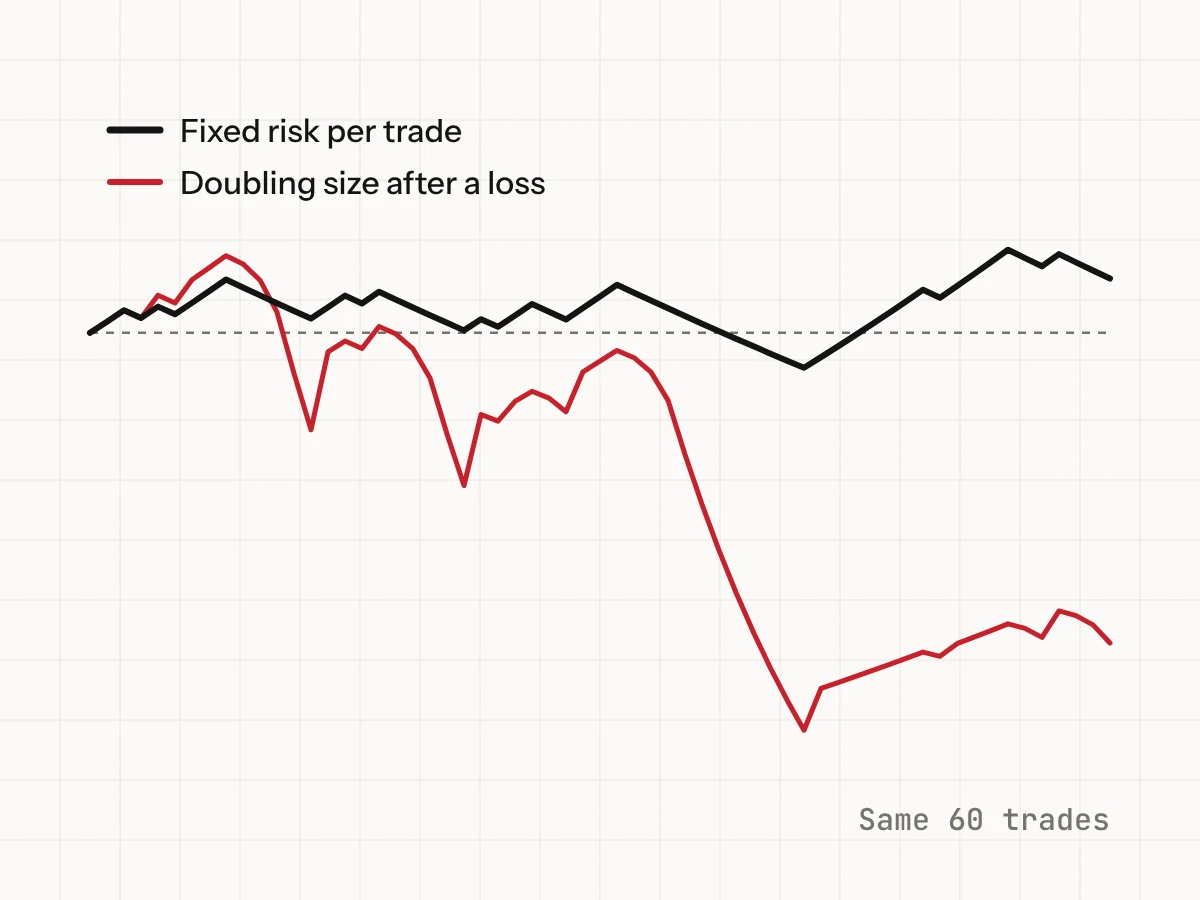
Your normal risk is $100 and you just lost it. You double the size on the next trade to get even. If it also loses, you are down $300 instead of $200, three times your normal risk in two trades.
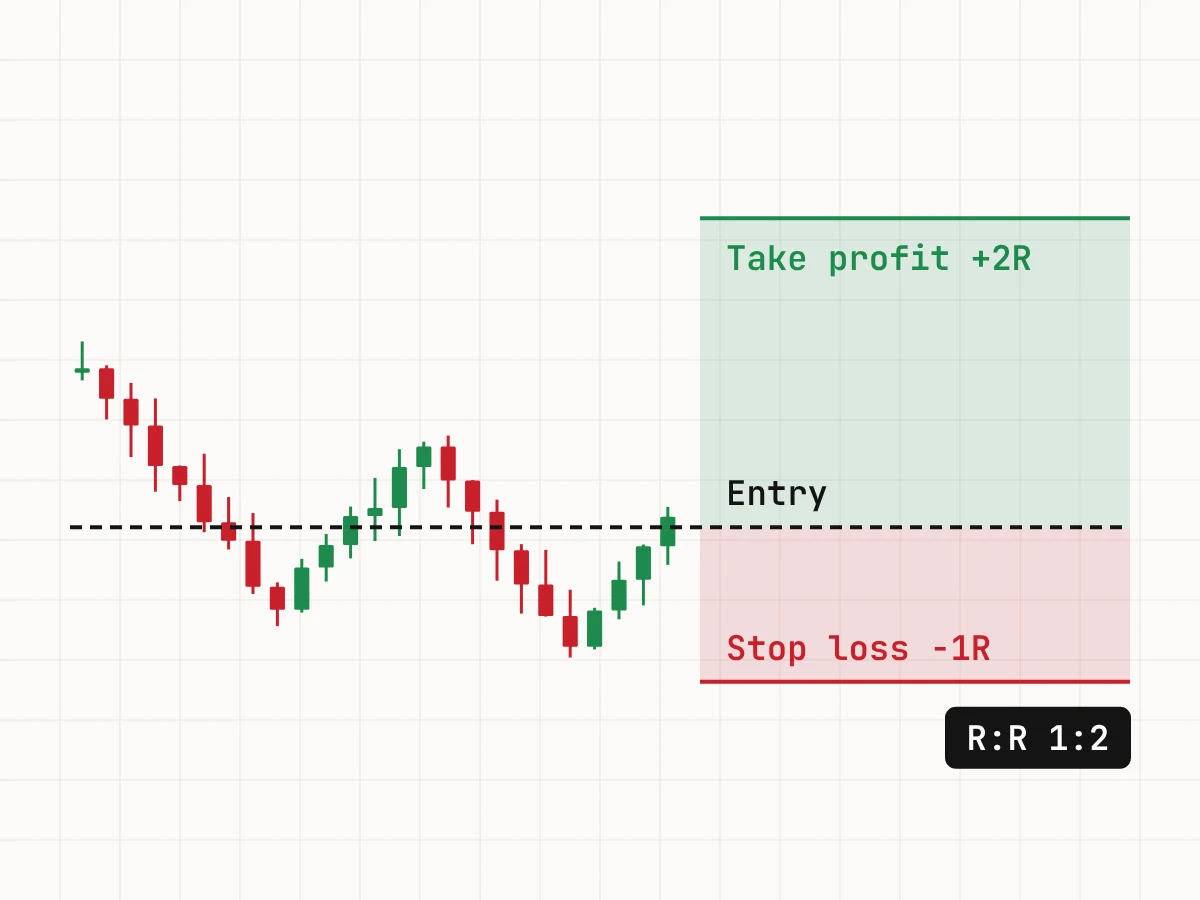
FOMO, the fear of missing out, pushes you into a move that has already happened. You enter late, without a setup, and with a stop that is either too tight or far away. Say EUR/USD jumps 80 pips in an hour after a release and you buy near the top. A stop below the start of the move is 80 pips away, while the next resistance may be only 20 pips higher. That is 20 ÷ 80 = 0.25R, a trade your plan would never allow.
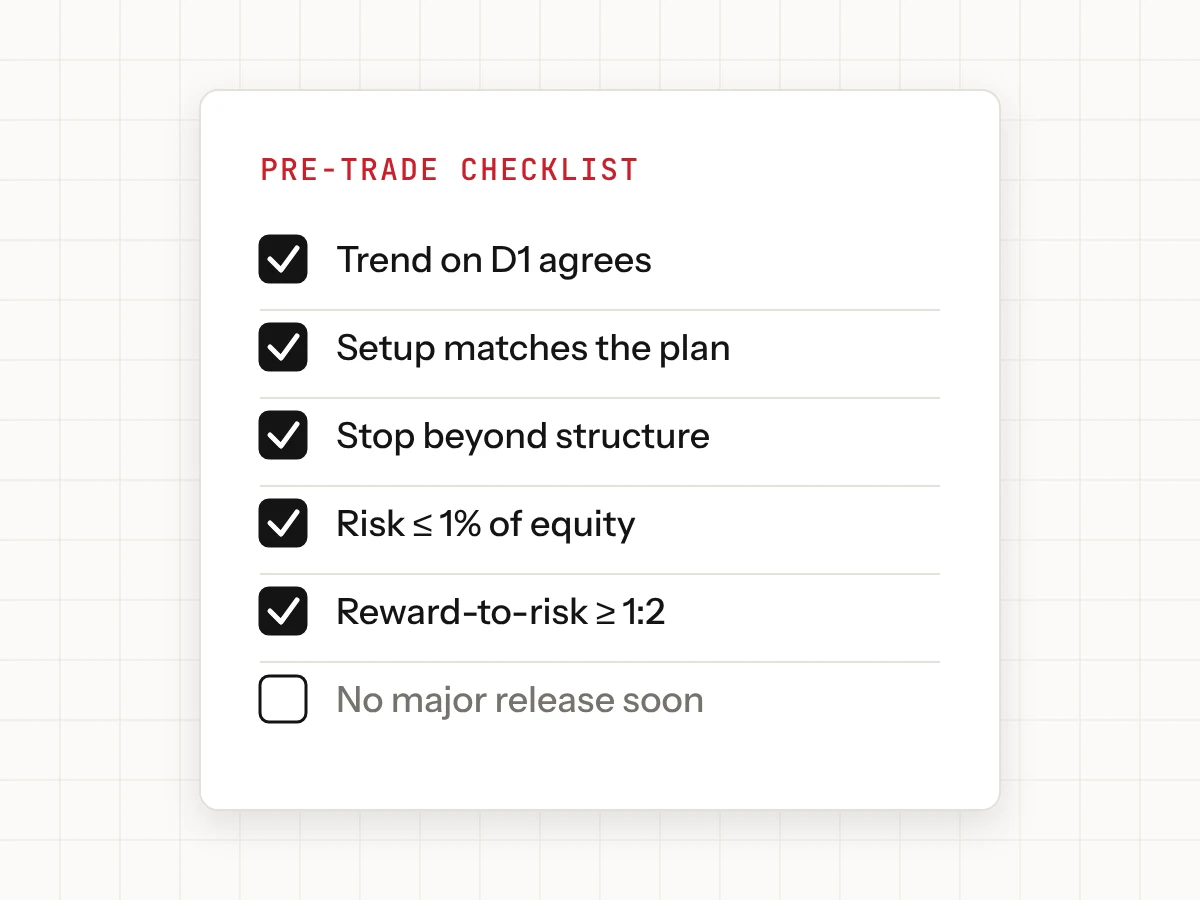
When you notice either urge, write it down as a missed or rejected trade in your journal and wait for a setup that passes your checklist. Another one will come.
Moving stops and overtrading
Moving a stop away from price to avoid a loss turns a planned 1R loss into 2R or 3R, and it usually happens on the trades where you are most sure you are right. Set a firm rule: a stop can move only in the direction of the trade, only as your plan describes, and never away from price. The stop loss and take profit guide covers where stops belong in the first place.
Overtrading follows both wins and losses. After a winning streak you feel you cannot miss, so you take weaker setups and bigger size. After losses you trade more to get back to even. Watch for these signs:
- You trade outside your hours or in markets that are not in your plan.
- You take more trades than usual, often on lower timeframes.
- You struggle to name the setup for a trade you just entered.
A daily maximum, for example three trades, removes the question entirely.
Think in a series of trades
The result of a single trade is close to random. Your edge, if you have one, shows up only over many trades. So judge your trading over the next 20 trades, not the next one.
Say your plan wins 40% of trades at 1:2, and you risk $100 per trade. Over 20 trades you might expect about 8 wins and 12 losses: 8 × $200 − 12 × $100 = $1,600 − $1,200 = +$400. With only 6 wins: 6 × $200 − 14 × $100 = $1,200 − $1,400 = −$200. Results like both are normal. If each trade is independent, the chance of at least four losses in a row somewhere in those 20 trades is about 72%, and of at least five in a row about 48%.
Losing streaks are part of the plan, not proof that it has stopped working. Ask a better question after each trade: did I follow my rules? A loss on a well-executed trade is a good trade. A win on a broken rule is a bad one, because it teaches you to break the rule again.
Routines that protect you
You will not get rid of emotions, but you can build routines that limit what they cost:
- Fixed risk: risk the same percentage on every trade, for example 1%. In SPM Trader you can enter it in the Risk (% equity) field and the platform calculates the lot size, so there is no room to size up on impulse.
- Stopping rules: for example, stop for the day after two losses or a 2% drawdown, whichever comes first. Many traders also stop after a large win, before overconfidence sets in.
- Emotions in the journal: before each trade, rate your state from 1 (calm) to 5 (agitated). At the monthly review, compare your results by rating.
- Breaks: after any closed trade, step away from the screen for 10 to 15 minutes. Price alerts by email and sound let you leave the chart without missing your levels.
Put these rules into your trading plan so they are decided before the pressure starts. Then practice them on a demo account until they are habits. You can open a free demo account and use the same routines from your first trade.
Key takeaways
- Fear and greed show up as cutting winners, skipping setups, sizing up and moving stops.
- After a loss, the next trade must meet the same rules at the same risk.
- Judge your results over a series of 20 trades or more, not over one.
- Use fixed risk, a daily stopping rule, an emotions rating in your journal and regular breaks.
This lesson is general education, not investment advice. Examples use illustrative numbers. CFDs are complex instruments and come with a high risk of losing money rapidly due to leverage.