How to read a currency pair
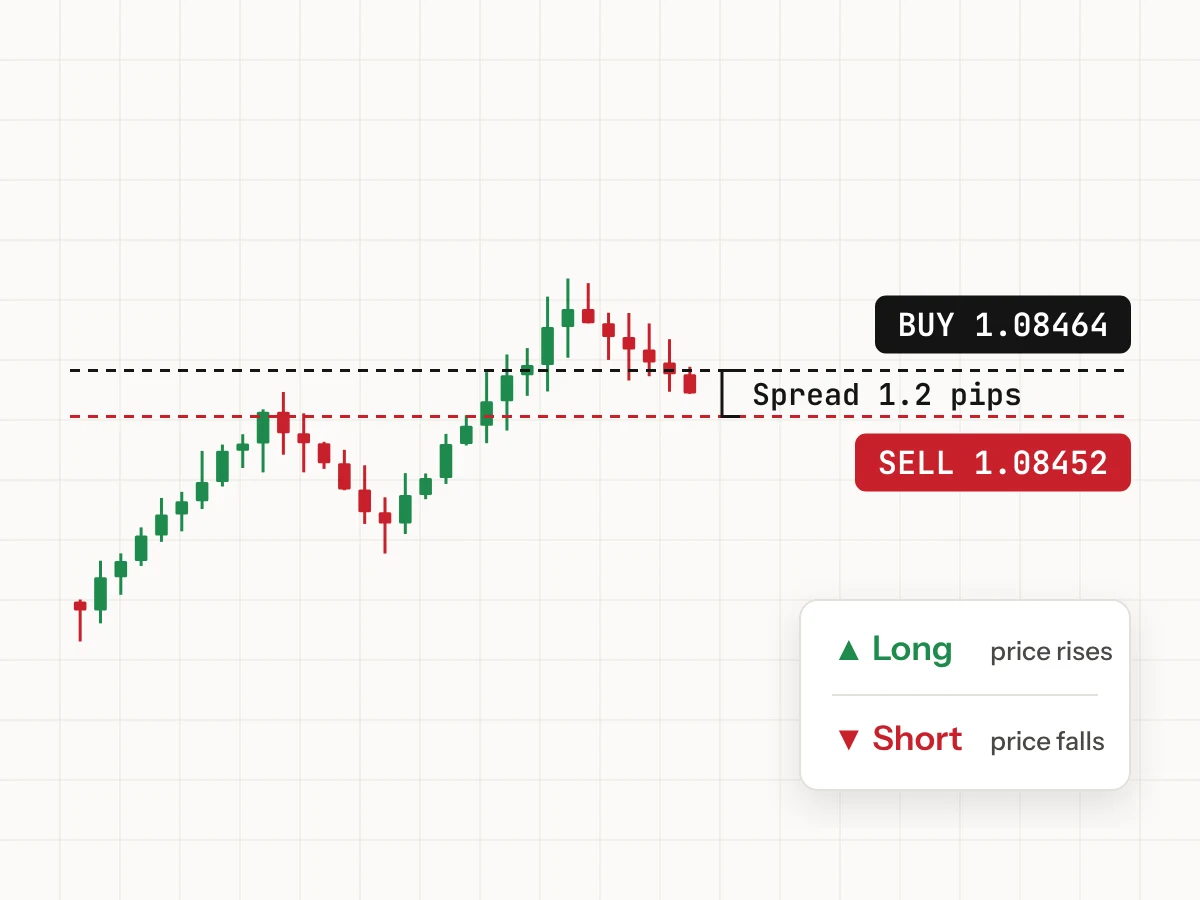
Every pair has a base currency, written first, and a quote currency, written second. The price tells you how many units of the quote currency one unit of the base buys. EUR/USD at 1.08450 means one euro costs 1.08450 US dollars.
If EUR/USD rises, the euro has strengthened against the dollar. That can happen because the euro gained, because the dollar weakened, or both, and the chart alone cannot tell you which. Buying EUR/USD means buying euros and selling dollars at the same time. Selling it means the opposite.
EUR/USD rises from 1.08000 to 1.09000. The euro has gained 100 pips against the dollar: one euro now buys 1.09 dollars instead of 1.08. A trader long 0.1 lots gains 100 × $1 = $100, while a trader short 0.1 lots loses $100. On USD/JPY, a rise from 150.00 to 151.50 means the dollar strengthened against the yen by 150 pips, because a yen pip is 0.01.
Interest rates and central banks
Interest rates are usually the biggest long-term driver. When a country’s rates rise, or are expected to rise, holding its currency earns more, which tends to attract money and support the currency. When rates are expected to fall, the reverse tends to happen. Often what matters most is the gap between two countries’ rates and which way that gap is heading.
Central banks set these rates. The ones behind the major pairs are:
- Federal Reserve (US dollar)
- European Central Bank (euro)
- Bank of England (British pound)
- Bank of Japan (Japanese yen)
- Swiss National Bank (Swiss franc)
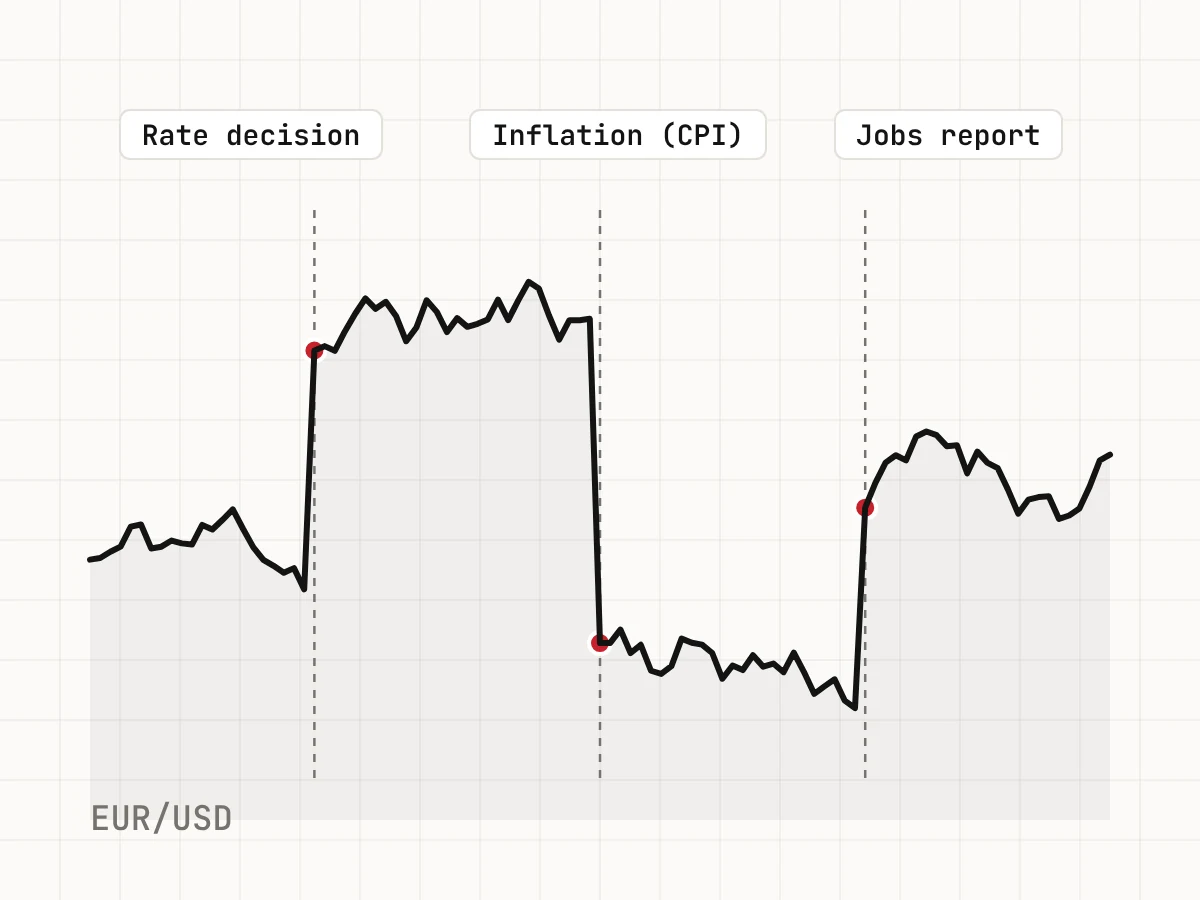
Markets trade expectations, not only decisions. A rate hike that everyone expected may barely move the currency, while an unexpected pause can move it sharply. The statement and the press conference matter as much as the decision itself, because they shape what traders expect next.
Note the next meeting date of each central bank behind the pairs you trade. Avoid opening a new position in the minutes before a decision unless trading the decision is your plan.
Inflation, growth and jobs data
Economic data moves currencies mainly through what it implies for interest rates. Higher-than-expected inflation can make a rate increase more likely, which often supports the currency. Weak growth or rising unemployment can do the opposite. The releases to watch fall into three groups:
- Inflation: the consumer price index (CPI) and producer prices
- Growth: GDP, purchasing managers’ indices (PMIs) and retail sales
- Jobs: US nonfarm payrolls, the unemployment rate and wage growth
What moves the price is the surprise, the gap between the actual number and the forecast. Spreads often widen around these releases and prices can jump, so a stop loss may fill at a worse price than its level. Trading around economic releases covers how to plan for them.
The forecast for US monthly CPI is 0.3% and the actual figure is 0.5%. Inflation is hotter than expected, so traders may price in higher US rates and the dollar may rise, which would push EUR/USD down. If the figure is 0.1%, the move may go the other way. Either reaction can fade or reverse within minutes, so the first move is not a reliable guide.
Risk sentiment and safe havens
When investors feel confident, often called risk-on, money tends to flow into stocks and into currencies with higher interest rates or close links to commodities, such as the Australian and New Zealand dollars. When fear rises, called risk-off, money tends to move into safe havens: the US dollar, the Japanese yen, the Swiss franc and gold.
These are tendencies, not rules, and they shift over time. A quick way to read the mood is to look at a major stock index such as the S&P 500 or the Nasdaq 100. A sharp sell-off there often comes with a falling AUD/JPY, as money moves from the Australian dollar into the yen.
Flows and positioning
Money also moves for reasons unrelated to the news of the day. Exporters convert foreign earnings, investors buy foreign stocks and bonds, and large funds rebalance at month end and quarter end. These flows can push prices for hours or days without any headline.
Positioning describes how many traders already hold one side. If most are already long a currency, good news may lift it only a little, because few buyers are left. A surprise against the crowd can then cause a fast move as many traders exit at once. In the US, the weekly Commitments of Traders report from the CFTC shows how large traders in currency futures are positioned.
This is why a currency sometimes falls on good news. The news may have been expected and already priced in, and traders who bought early take their profits.
A checklist before you trade a pair
Put the drivers together into a short routine you can run in a few minutes:
- Name the base and the quote and state your view in both: buying GBP/USD means you expect the pound to do better than the dollar.
- Check the calendar for central bank meetings and major data for both currencies this week.
- Note the risk mood using a major stock index.
- If a big release falls inside your planned trade, reduce the size or wait until after it.
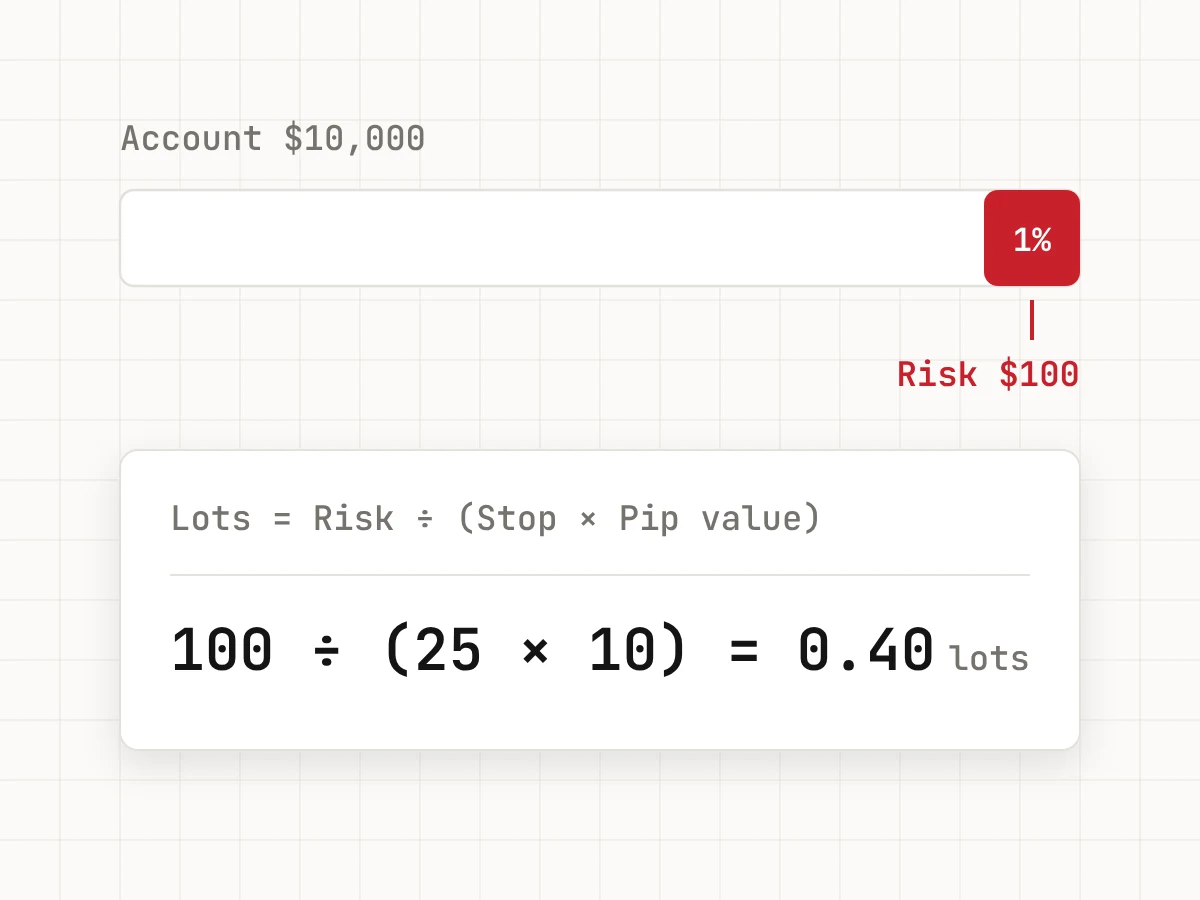
- Set your stop and size the position before you enter, as shown in Managing risk and position size.
None of these drivers tells you where the price will be tomorrow. They help you understand why a pair is moving and when the risk of a sharp move is higher, which is what you need to size and time a trade sensibly.
Key takeaways
- In a pair like EUR/USD, a rising price means the base currency (euro) is strengthening against the quote (dollar).
- Interest rate expectations are usually the biggest long-term driver, and surprises move prices more than expected decisions.
- Data matters through its effect on rates. The gap between actual and forecast is what moves the price.
- In risk-off periods, money tends to move to the dollar, yen, Swiss franc and gold.
- Check the calendar before every trade and reduce size or wait around major releases.
This lesson is general education, not investment advice. Examples use illustrative numbers. CFDs are complex instruments and come with a high risk of losing money rapidly due to leverage.