What a CFD is
A CFD (contract for difference) is an agreement between you and your broker to settle the difference in an asset’s price between the moment you open a position and the moment you close it. You never own the asset itself. You hold no shares, no gold bar and no bitcoin wallet. You trade the price, and your profit or loss is paid in your account currency.
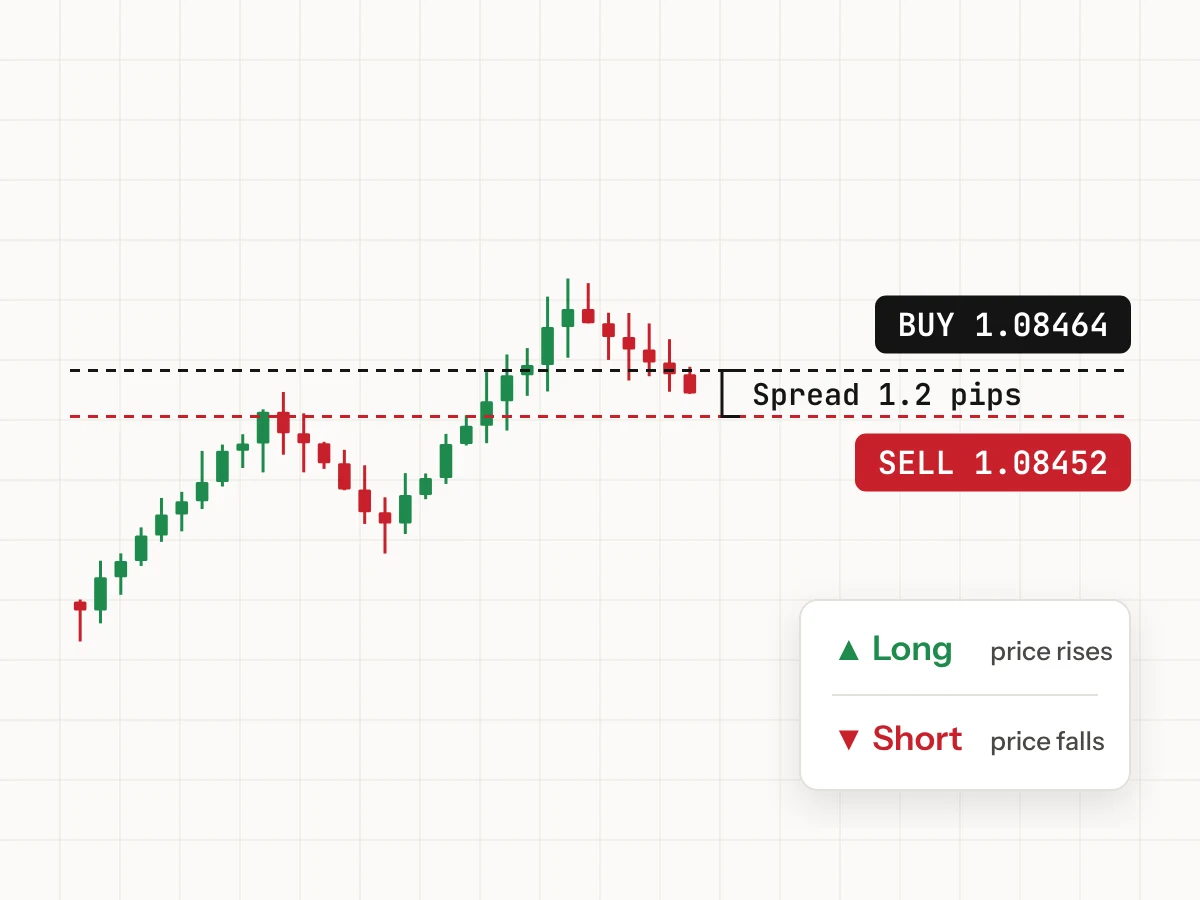
Because you trade only the price, you can take either side of a market. Going long means you buy because you expect the price to rise. Going short means you sell first because you expect the price to fall, and you buy back later to close. A short position works exactly like a long one in the opposite direction, so it loses money when the price rises.
Through CFDs, one account can give you access to many kinds of markets:
- Forex pairs, such as EUR/USD or USD/JPY
- Stock indices, such as the Nasdaq 100 or the S&P 500
- Metals, such as gold
- Cryptocurrencies, such as bitcoin
- ETFs, which track a basket of assets
Say gold trades at $2,400.00 and you buy a position equal to 10 ounces. If gold rises to $2,415.00, the position gains $15.00 × 10 = $150. If gold falls to $2,385.00 instead, it loses $15.00 × 10 = $150. A short position of the same size would do the reverse: lose $150 in the first case and gain $150 in the second. Costs such as the spread reduce the gain or add to the loss in every case.
CFDs also come with costs and features that owning the asset does not. You pay the spread on every trade, which the next lesson explains. If you keep a position open past the daily rollover, most brokers charge or pay a small overnight financing amount, often called a swap. CFDs are traded on margin, which means you put up only part of the position’s value. That makes them flexible, and it also means losses can grow quickly compared with your deposit.
The rest of this course takes these pieces in order, so that by lesson six you can place a trade with a defined maximum loss.
Before you trade any market, open its contract specification in your platform. Note the contract size, the smallest lot you can trade, the trading hours and how overnight financing is charged.
Prices: bid, ask and the spread
Every CFD has two prices at any moment. The bid is the price at which you can sell. The ask, also called the offer, is the price at which you can buy. The ask is always higher than the bid, and the gap between them is the spread.
When you buy, you open at the ask and later close by selling at the bid. When you sell, you open at the bid and later close by buying at the ask. Either way, a new position starts with a small loss equal to the spread. The price has to move in your favor by at least the spread before the trade breaks even.
Say EUR/USD shows a bid of 1.08452 and an ask of 1.08462. The spread is 1.08462 − 1.08452 = 0.00010, which is 1.0 pip. On a 1-lot position a pip is worth $10, so the spread costs you $10 the moment you open. On 0.1 lots it costs $1, and on 0.01 lots it costs $0.10. If you buy at 1.08462, the bid has to rise to 1.08462 before you can close without a loss.
For most beginners the spread is the main trading cost, and you pay it on every trade, win or lose. If you trade often with small targets, it takes a large share of each result. A 1-pip spread is 10% of a 10-pip target, but only 2% of a 50-pip target.
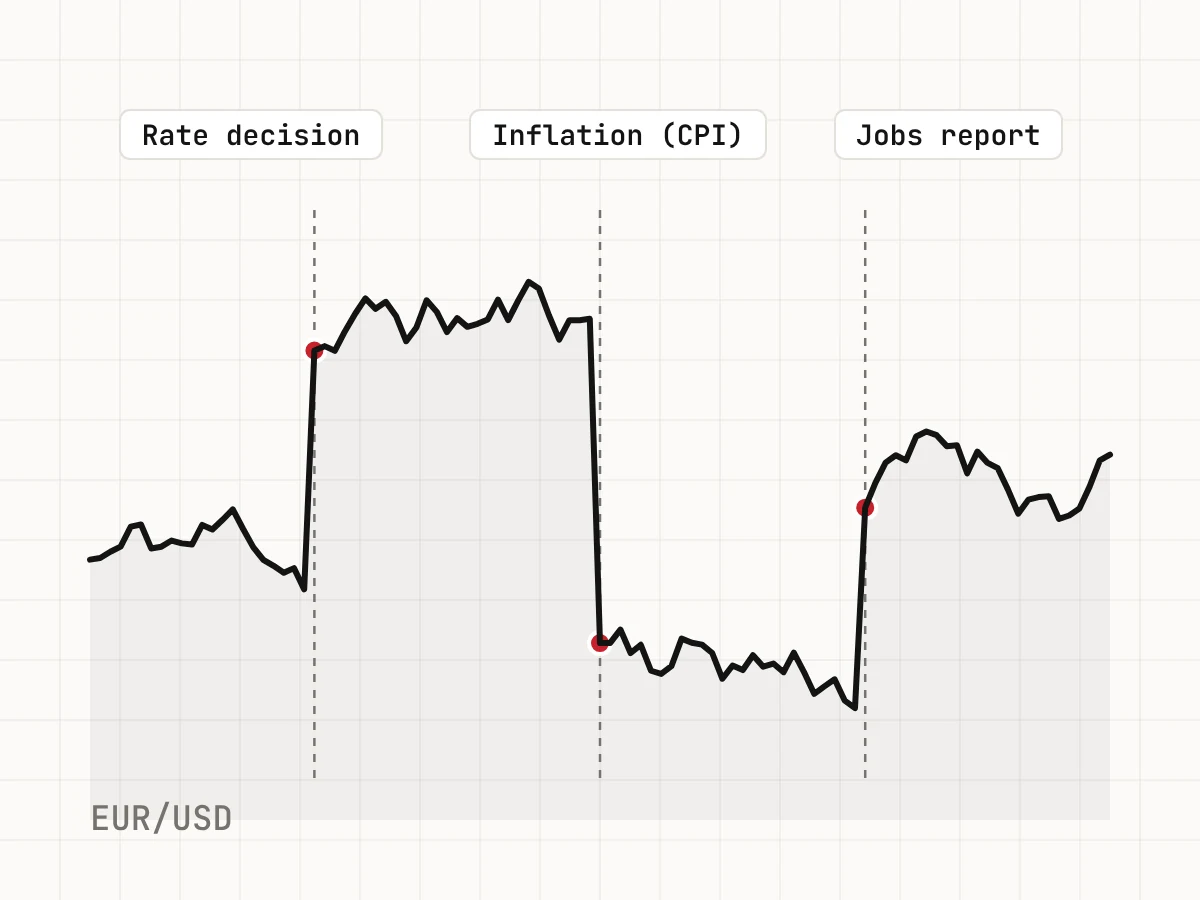
Spreads are not fixed. They usually widen when fewer people are trading, for example around the daily rollover, at the weekly open and in quiet holiday sessions. They can also widen sharply in the seconds around major economic releases.
The two prices also matter for stops. A long position is closed at the bid, so its stop loss triggers when the bid reaches your level. A short position is closed at the ask, so its stop loss can trigger when the ask touches your level, even if the bid never gets there.
Some accounts also charge a commission per lot, and positions held overnight pay or receive a swap. Check your account terms for the full cost of a trade.
Before you open a trade, read the current spread in pips and multiply it by the pip value of your position. That is what the trade costs you up front, and it tells you whether your target is large enough to be worth it.
Pips, lots and what a position is worth
A pip is the standard unit for price moves in forex. For most pairs it is the fourth decimal place, 0.0001. For pairs quoted in Japanese yen, such as USD/JPY, it is the second decimal place, 0.01. Many platforms show one more digit, called a pipette or point, which is one tenth of a pip. In the EUR/USD price 1.08452, the last digit (2) counts pipettes, so a move from 1.08452 to 1.08552 is 10 pips.
Position size in forex is measured in lots:
- 1 standard lot = 100,000 units of the base currency
- 0.1 lot (mini) = 10,000 units
- 0.01 lot (micro) = 1,000 units
For pairs quoted in US dollars, such as EUR/USD, GBP/USD and AUD/USD, one pip is worth $10 per standard lot, $1 per 0.1 lot and $0.10 per 0.01 lot. Pip value grows in direct proportion to size: 0.5 lots means $5 per pip, and 2 lots means $20 per pip.
The full market value of a position is lots × contract size × price. This is the exposure you carry, even though you only put up a fraction of it as margin.
You buy 0.2 lots of EUR/USD at 1.08450. The position value is 0.2 × 100,000 × 1.08450 = $21,690. Each pip is worth 0.2 × $10 = $2. If the price rises to 1.08750, that is 30 pips, a gain of 30 × $2 = $60. If it falls to 1.08150 instead, that is also 30 pips, a loss of 30 × $2 = $60. The spread comes off the result either way.
For pairs quoted in other currencies, the pip value is worked out in the quote currency first and then converted. On USD/JPY, one pip on a standard lot is 100,000 × 0.01 = 1,000 yen, which is about $6.67 when USD/JPY is at 150.00. The guide Managing risk and position size works through a full JPY example.
Gold, indices and crypto do not use the forex lot. Their contract size, and so the value of a one-point move, differs from broker to broker. Find it in the platform’s contract specification before you trade, then use the same idea: value of a move = lots × contract size × size of the move.
Write down the pip or point value of each market you trade at the size you normally use. Knowing that 0.1 lots of EUR/USD is $1 per pip makes every later decision faster.
Leverage and margin in brief
Leverage lets you open a position that is larger than the money you put up for it. The money set aside to keep the position open is called margin. Margin is a deposit, not a fee: it is released when you close the trade, and your profit or loss is added to or taken from your balance.
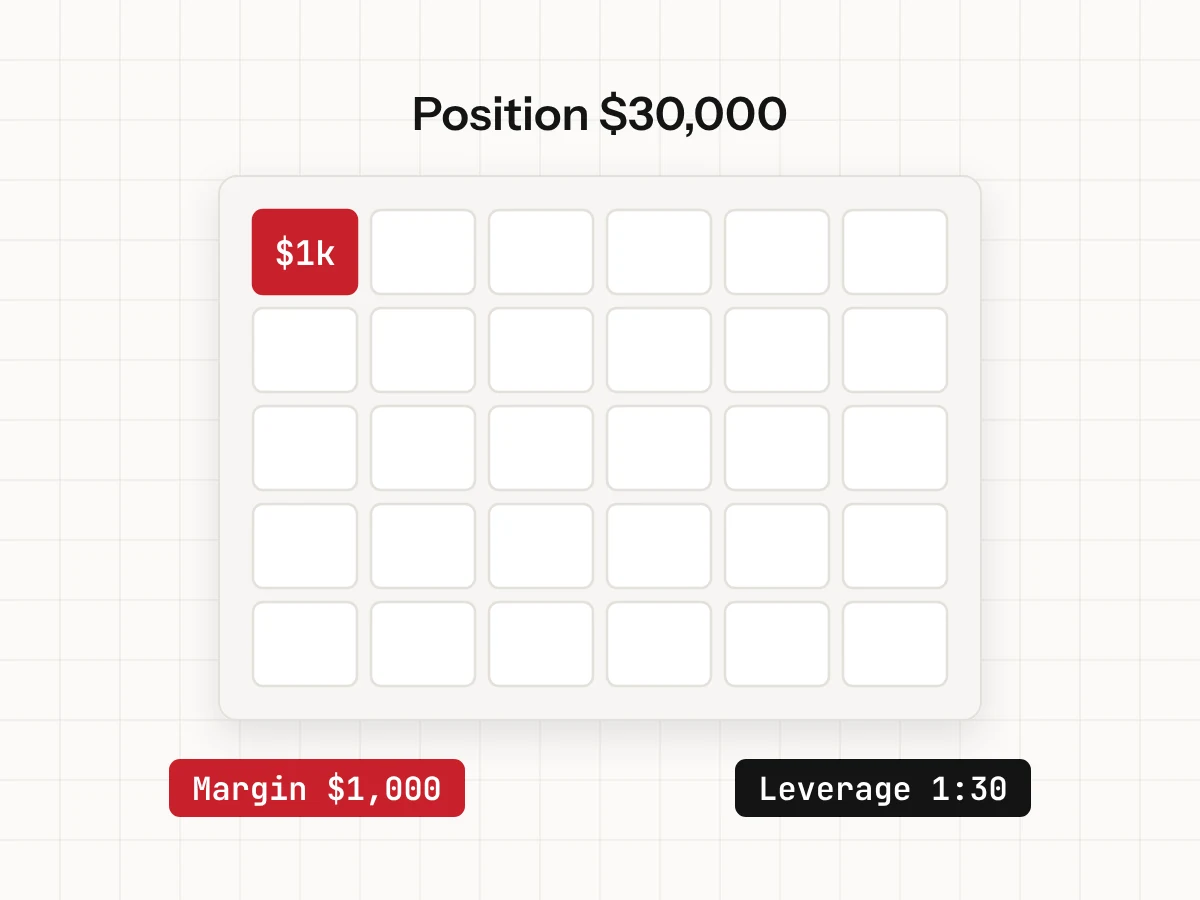
Leverage is written as a ratio, and the margin you need is the position value divided by the leverage:
- At 1:30, margin is 1 ÷ 30 = 3.33% of the position value
- At 1:100, margin is 1 ÷ 100 = 1%
- At 1:500, margin is 1 ÷ 500 = 0.2%
Say your broker offers 1:30 on EUR/USD and the price is 1.08450. One standard lot is worth 1 × 100,000 × 1.08450 = $108,450, so the margin is $108,450 ÷ 30 = $3,615. At 1:100 it would be $108,450 ÷ 100 = $1,084.50. A 0.1-lot position at 1:30 needs $10,845 ÷ 30 = $361.50.
Leverage does not change what a pip is worth. One lot of EUR/USD moves $10 per pip whether it uses $3,615 or $1,084.50 of margin. What leverage changes is how large a position your account lets you open, and so how much you can lose compared with what you deposited. Picture a $5,000 account holding 1 lot of EUR/USD at 1:100. The margin of $1,084.50 looks modest, but a 100-pip move against you costs 100 × $10 = $1,000, which is 20% of the account. EUR/USD can move 100 pips in a few days, and sometimes in a single day.
Your platform also tracks free margin, the money still available for new positions and for absorbing losses, and margin level, which compares your equity with the margin in use. If losses push the margin level down to the broker’s margin call level, you get a warning. If it falls further to the stop out level, the platform starts closing positions for you. Each broker sets its own levels, so look them up in your account terms.
The guide Leverage and margin explained covers free margin, margin level and stop outs with full worked examples.
Treat the maximum leverage as a limit, not a target. Decide your position size from your stop loss and the amount you are willing to lose, as shown in lesson six, then check that the margin it needs leaves plenty of free margin.
Placing your first order
A market order buys or sells right away at the best price available. A buy fills at the ask and a sell fills at the bid. In a fast market the fill can differ from the price you saw. That difference is called slippage, and it can go against you or in your favor.
A pending order waits until the price reaches a level you choose. The common types are:
- Buy limit: buy below the current price, if it dips to your level
- Sell limit: sell above the current price, if it rises to your level
- Buy stop: buy above the current price, if it breaks higher
- Sell stop: sell below the current price, if it breaks lower
Two more levels close a position for you. A stop loss closes it when the price moves against you to a set level, which caps the planned loss. A take profit closes it when the price reaches your target. A stop loss is not a guarantee: if the market gaps over a weekend or jumps on news, the position closes at the next available price, which can be worse than your level.
In SPM Trader, the order ticket keeps these choices in one window. With the order type set to Market Execution, you can enter your risk in the Risk (% equity) field together with a stop loss, and the platform calculates the lot size before you click. Stop loss and take profit can be set as a price, in pips or in dollars. You then click Sell by Market or Buy by Market. Pending orders are available as well, for when you want to wait for a price.
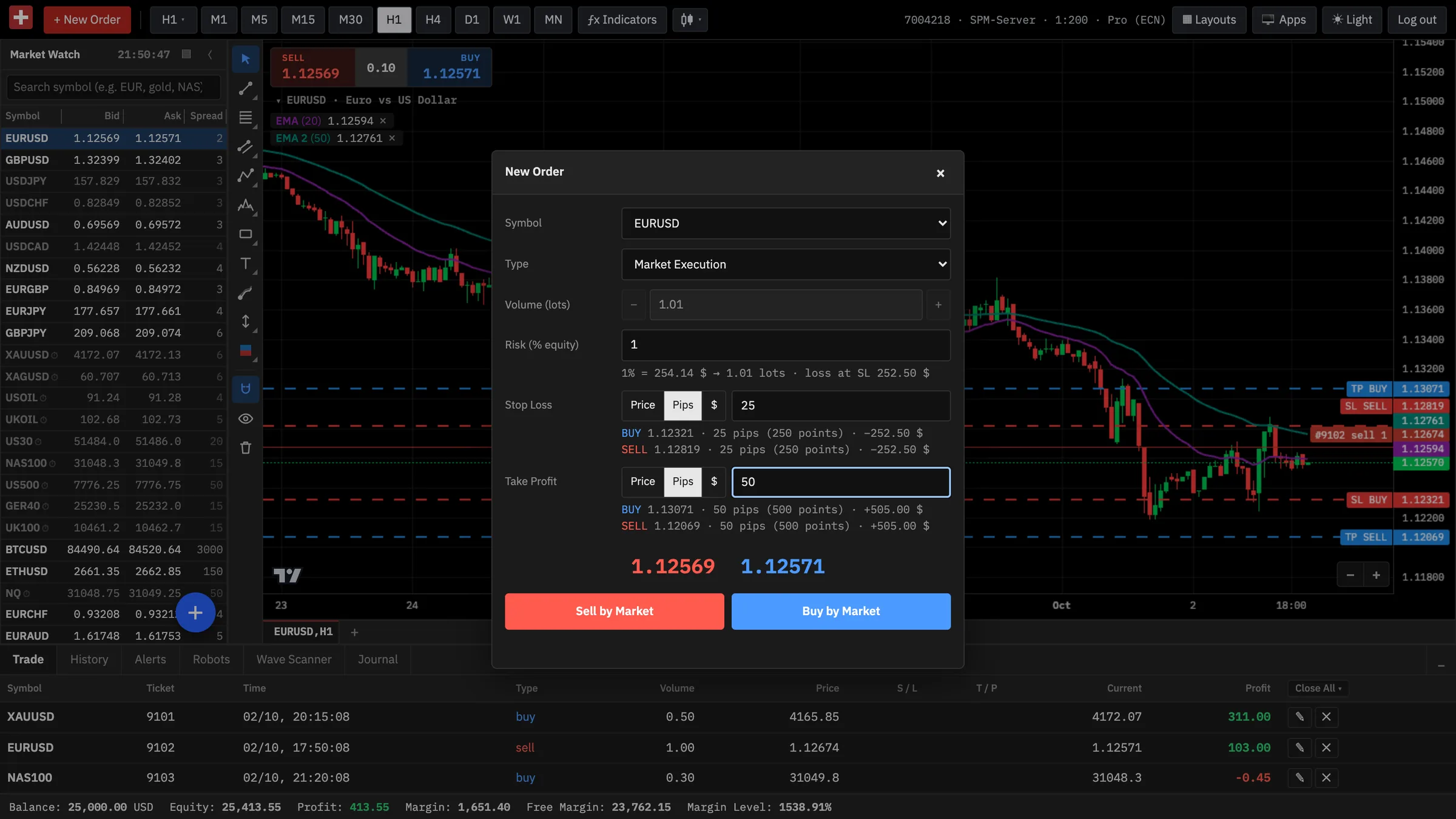
A simple routine for every order:
- Open the order ticket for the market you want and check the current spread.
- Decide where the stop loss goes, at a level where your trade idea would be wrong.
- Set the size so that hitting the stop costs only what you planned.
- Set a take profit, or decide in advance how you will manage the exit.
- Check the dollar amounts shown for the stop loss and the take profit.
- Click Buy by Market or Sell by Market, then check that the open position shows your stop loss and take profit.
Practice placing, changing and closing orders on a demo account until each step is routine. Mistakes such as selling instead of buying, or typing one zero too many in the size, cost nothing there.
Sizing a position so one trade can’t hurt your account
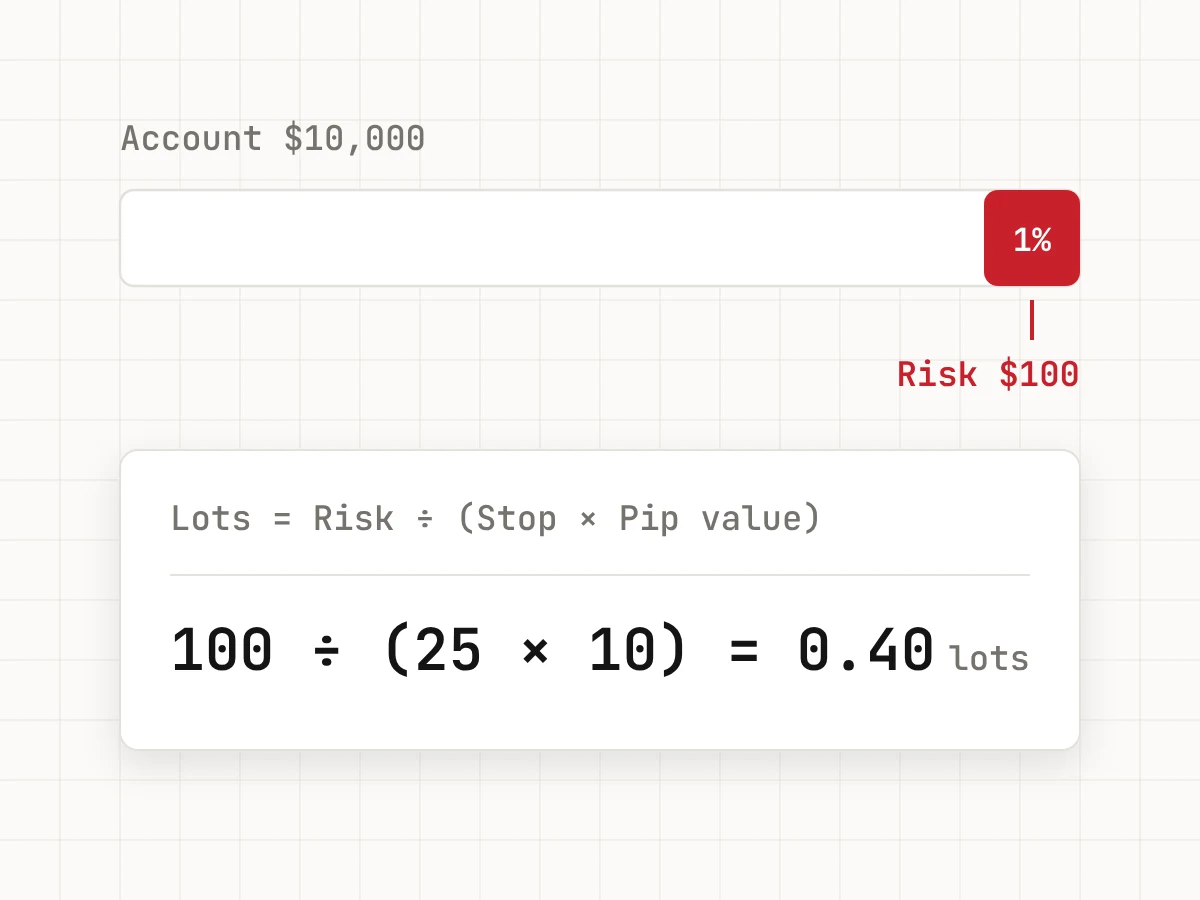
Size decides how much a single trade can cost. A widely used rule is to risk no more than about 1% of your account on any one trade. Risk here means the amount you lose if the stop loss is hit, not the margin and not the position value.
To turn that rule into a size, use one formula: position size (lots) = money at risk ÷ (stop distance in pips × pip value per lot).
Your account is $10,000, so 1% is $100. You plan to buy EUR/USD at 1.08450 with a stop loss at 1.08200, which is 25 pips away. One lot is worth $10 per pip. Size = $100 ÷ (25 × $10) = $100 ÷ $250 = 0.4 lots. At 0.4 lots each pip is worth $4. If the stop is hit, you lose 25 × $4 = $100, plus the spread. If the price reaches a target 50 pips away instead, you gain 50 × $4 = $200, minus the spread.
Notice the order: the stop comes first, and the size follows from it. If your analysis calls for a 50-pip stop, the size becomes $100 ÷ (50 × $10) = 0.2 lots. The dollar risk stays at $100 either way. A wider stop means a smaller position, not a bigger loss.
Small risk matters because losing streaks are a normal part of trading. If you risk 1% of the current balance on each trade, ten losses in a row take a $10,000 account to about $9,044. At 5% per trade, the same streak leaves about $5,987, and getting back to $10,000 then needs a gain of about 67%.
SPM Trader can do the arithmetic for you. Enter your Risk (% equity) and your stop loss in the order ticket, and the platform calculates the lot size before you click. You still choose the stop and the risk; the ticket only does the math.
Build these habits on a demo account, which comes with up to $100,000 in virtual funds. If you plan to start live with less, size demo trades as if the account were that size, so 1% means the same in both. You can open a free demo account and follow this routine:
- Pick one market, such as EUR/USD, and learn its spread and pip value.
- Before each trade, write down the entry, stop loss, target and size.
- Place the order with the stop loss attached from the start.
- Record the result in dollars and as a percentage of the account.
- After 20 trades, review what worked, what did not and whether you kept to 1%.
Key takeaways
- A CFD lets you trade a price up or down without owning the asset, and losses are as real as gains.
- You buy at the ask and sell at the bid, so the spread is a cost on every trade.
- On USD-quoted pairs, 1 pip is $10 per standard lot, $1 per 0.1 lot and $0.10 per 0.01 lot.
- Margin is a deposit. Leverage changes how much you can open, not what a pip is worth.
- Set the stop first, then size the position so a loss costs about 1% of your account.
This lesson is general education, not investment advice. Examples use illustrative numbers. CFDs are complex instruments and come with a high risk of losing money rapidly due to leverage.